New West Reviews the Political Roller Coaster of 2025
2025 delivered leadership drama, snap elections, trade tremors, and a national unity storyline nobody asked for (thanks Donald). Institutions bent, narratives broke, and every government learned the same lesson that events happen whether you’re ready or not. Here’s our quick tour through the damage and the decisions that shaped it.
Top Federal Stories
Chrystia Freeland forces Justin Trudeau to take a walk in the snow
The federal story of 2025 really starts in Ottawa on a cold December day in 2024. Then Prime Minister Justin Trudeau sought to replace his then-Finance Minister Chrystia Freeland with the politically untested former Governor of the Bank of Canada, Mark Carney. But Ms. Freeland refused the Prime Minister’s plan and instead stole the show by releasing a letter announcing she was leaving Trudeau’s cabinet in an incisive rebuke of his embattled leadership and fiscal policies.
Using her pen as her sword, Freeland brought to an end Justin Trudeau’s leadership of the Liberal Party of Canada. Beleaguered and with no options left, Trudeau could hold on no longer and announced last January 6th that he would resign as Prime Minister following a Liberal leadership election.
The pundits doubted Mark Carney and they were wrong
Having never been in a leading role, Mark Carney then made an attempt to be a star and succeed at the biggest job in Canadian politics. Conventional wisdom doubted him nearly every step of the way. He’s too dry. He’s too technocratic. He doesn’t talk like a politician. Beyond that, he doesn’t even know how to play the game of politics. He was criticized for launching his campaign for leadership on an American broadcast, the Daily Show with Jon Stewart, but from there Carney secured a dominant victory in the race to replace Justin Trudeau winning over 85% of the vote.
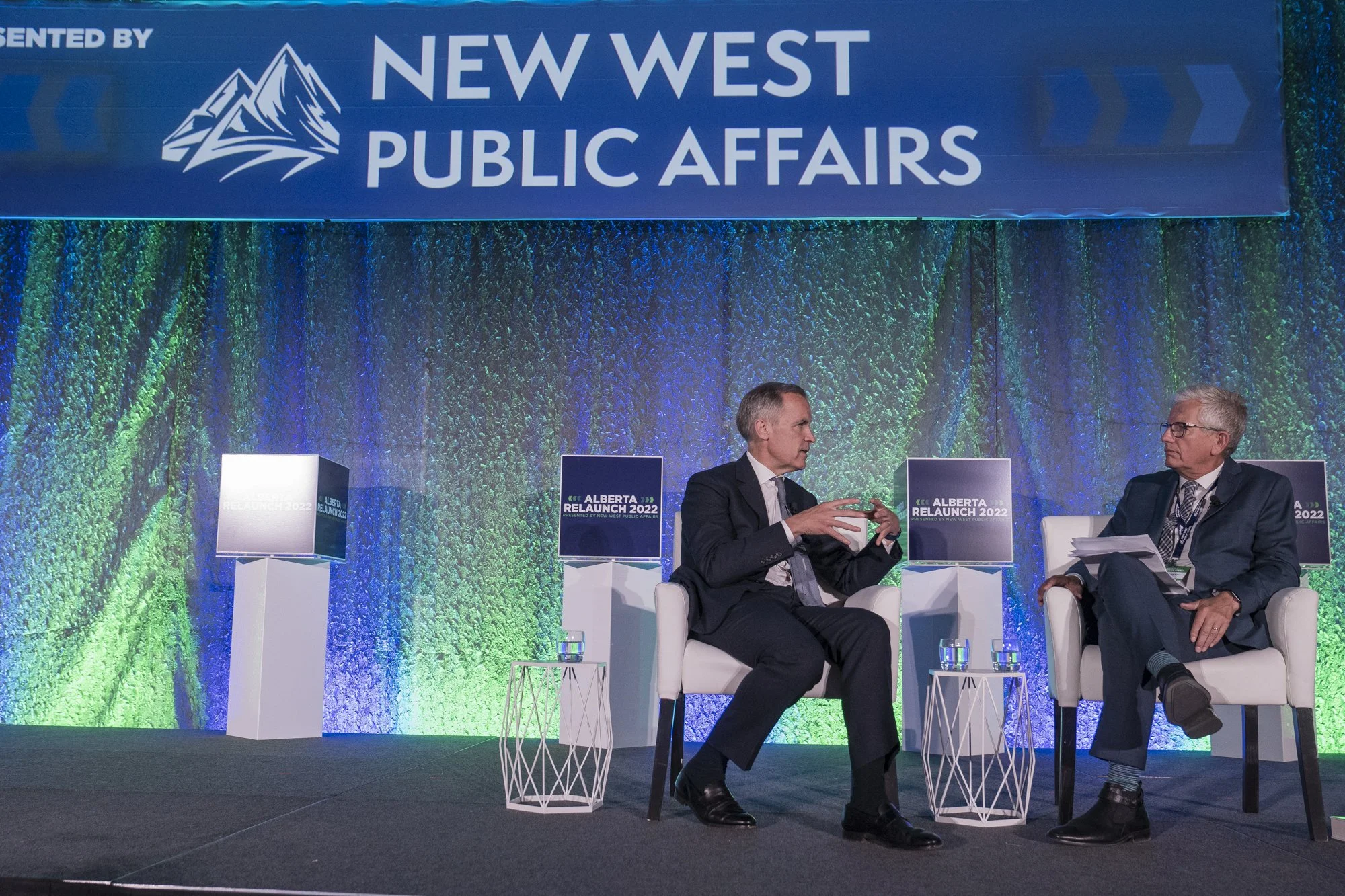
Prime Minister Carney speaks with New West Public Affairs CEO Monte Solberg at Alberta Relaunch in June 2022.
Carney inherited a government plagued with Trudeau-era fatigue, but it was US President Donald Trump’s tariff barrage and his recurring “Canada as the 51st state” riff that turned Canadian politics and the upcoming election on its head. In this environment, Carney’s calm, banker-ish steadiness stopped looking like a personality flaw and started reading like the leadership Canada needed. He was less charisma and more crisis management. He called the election explicitly as a response to the moment, and what followed was not a replay of the carbon tax years, but a campaign that embraced a very different theme.
An election about Canada’s sovereignty and not the carbon tax
The 2025 election stopped being a debate about the carbon tax the moment US President Donald Trump started talking about annexing Canada. While Pierre Poilievre kept swinging at an old target, Mark Carney aimed straight at the new one. He wrapped himself in red and white and launched TV ads with Mike Myers where he was clad in Team Canada hockey jerseys that read “Never 51.”
These ads ran in February when Canada beat the United States in overtime to win the 4 Nations Face-Off. It was our country’s most politically meaningful hockey game since 1972, and an outpouring of Canadian nationalism ensued. Carney rode that same wave into the campaign he framed as a sovereignty and economy fight for a Canada that he promised would stay intact, be unapologetic, and never be up for sale.
Pierre Poilievre and the Conservatives seemed timid to engage this national sentiment. In the end, the election was less like a referendum on Justin Trudeau. It was more like a Tragically Hip song about defiance and anxiety. A courage under pressure that felt like something familiar and was weirdly unifying. Pierre Poilievre never quite heard that music.
Mark Carney: the Progressive Conservative Prime Minister
On some days, Conservatives describe Mark Carney as a hard-left ideologue in a red tie. On other days, they accuse him of being a “counterfeit Conservative” because he keeps stealing their ideas. The second critique is closer to the mark. Based on Carney’s early governing posture, he is the closest thing Canada has seen to a Progressive Conservative prime minister since Brian Mulroney.
Like Mulroney, PM Carney seems willing to make high-stakes bets in the name of national interest, even if those wagers upset parts of his own coalition. Mulroney did it with free trade and a full-spectrum reorientation of Canada’s economic future. Carney is trying to do it with a sovereignty and trade agenda that treats energy, market access, and investment attraction as items of core national interest. The clearest example is the Canada–Alberta energy MOU, where Ottawa agreed it would not implement the federal oil-and-gas emissions cap and would suspend the Clean Electricity Regulations in Alberta while the two governments negotiate a new industrial carbon pricing arrangement.
Carney’s bet is that Canadians will reward results over purity, and that a credible “national interest” frame can hold even when it creates internal friction. That bet is not yet proven, and 2026 will tell a lot of the tale. Whatever happens next year, 2025 shows that observers should be cautious in underestimating the political skill and appeal of Mark Carney.
Top Alberta Stories
Alberta vs. Everyone
2025 was defined by Alberta’s relentless external focus, first south to Washington, then east to Ottawa as Premier Danielle Smith positioned energy security as both economic strategy and political identity.
The year opened with Alberta bracing for the return of Donald Trump and the re-emergence of tariff threats. While other premiers leaned toward retaliation, Smith chose diplomacy and proximity, appearing on U.S. media, travelling frequently to Washington, and making the case that Alberta energy is inseparable from American economic security. That approach put her at odds with former Prime Minister Justin Trudeau, who accused her of not putting Canada first after she was the only premier who didn’t sign a joint statement laying out the country’s plans to tackle the tariff threat.
As tariffs became a semi-permanent feature of the global landscape, Alberta’s strategy expanded. Smith revived long-dormant pipeline conversations, floated new west-coast and eastbound corridors, and ultimately took the unprecedented step of having the province act as proponent for a proposed pipeline to the northwest coast of British Columbia. Energy policy became inseparable from questions of national unity, Indigenous partnership, and investor confidence.
By late fall, this approach yielded a political breakthrough: a Canada-Alberta Memorandum of Understanding that addressed several long-standing provincial grievances, including the federal emissions cap. While skeptics cautioned that progress would depend on implementation, the agreement marked a rare intergovernmental win and significant reset to the previously tense relationship between Alberta and Ottawa.
Throughout the year, Smith framed energy not only as Alberta’s economic engine but as a strategic asset for Canada, an argument that gained traction as Ipsos polling showed broad national support for expanding oil and gas exports and pipeline capacity amid the U.S. trade war.
Sovereignty Without Separation
If energy defined Alberta’s external posture in 2025, sovereignty defined its internal debate.
From the lowering of referendum thresholds to the launch of the Alberta Next panel, the Smith government spent much of the year walking a tightrope of validating frustration with Confederation while encouraging provincial sovereignty “within a United Canada.” Polling pointed to a polarized but largely pro-Canada electorate: while a vocal minority of Albertans strongly supported separation, attachment to Canada also increased.
The Alberta Next panel became the focal point of this conversation. Chaired by Premier Danielle Smith and billed as an opportunity to discuss how Alberta can better assert its place in Confederation, its town halls revealed deep divisions. Some Albertans were eager to see the proposed policies implemented while others were alarmed by the framing of questions, including withholding social programs to non-citizens. The panel’s work ran parallel to citizen-led initiatives pulling in opposite directions - one petition to reaffirm Alberta’s place in Canada, another seeking a referendum on independence.
Premier Smith consistently rejected separation, but refused to remove it from the conversation entirely, arguing that suppressing the debate would only fuel more extreme movements. That strategy helped her contain pressure from within her own base, even as opposition leader Naheed Nenshi launched a competing ‘Better Together Summer’ tour to reclaim the pro-Canada narrative.
By year’s end, the debate had moved from rhetoric to rules. The Alberta Next panel delivered its final report, recommending a series of concrete steps to enhance Alberta’s sovereignty within a united Canada, including potential referendums on immigration control and constitutional reform.
Pressure Points at Home
Health care and education became the year’s defining domestic files, as ambitious reforms, labour unrest, and high-stakes legislative decisions took centre stage.
The government pressed ahead with a sweeping restructuring of the healthcare system, dismantling Alberta Health Services into four new agencies and appointing new ministers to oversee each pillar, even as allegations of political interference in procurement dominated headlines. Auditor General and RCMP investigations, as well as the resignation of former Infrastructure Minister, Peter Guthrie, over procurement concerns kept the issue alive through the spring, while wages and working conditions strained relationships with frontline providers.
Education proved just as disruptive this year, as a provincewide teachers’ strike shut classrooms for weeks. The strike was one of the largest and longest of its kind in Alberta, affecting more than 700,000 students and culminating in back-to-work legislation that invoked the notwithstanding clause. The decision drew national attention, legal challenges, and deepened distrust between government and educators, even as the province later moved to address class size and complexity through a new cabinet committee.
Across both files, a pattern emerged: the government moved quickly and decisively - willing to absorb criticism in order to keep a firm grip on outcomes.
Movement at the Margins
Politically, the year brought movement but little realignment. Alberta NDP leader Naheed Nenshi finally entered the legislature, a long-anticipated moment that raised expectations but produced a relatively muted impact as the opposition continued to search for a dominant narrative amid sovereignty and energy debates.
While the NDP stayed largely stagnant, the Alberta Party experienced an unexpected revival. Widely written off after being shut out of the legislature in 2019, the party had faded from relevance as Alberta politics hardened into a two-party contest. That began to shift late in 2025, when former UCP cabinet minister Peter Guthrie stepped into the Alberta Party leadership following legislative changes that blocked his efforts to rebrand under the Progressive Conservative name. The move thrust the party back into the political conversation. While it’s likely not a governing alternative, it could attract disaffected conservatives and centrists, voters the NDP needs if they want a path to victory in the next election.
For the governing UCP, 2025 was less about expansion than consolidation. The party remained firmly in control of the legislature and the political agenda, even as recall petitions, internal tensions, and contentious policy files persisted. The launch of Alberta’s electoral boundary review, prompted by rapid population growth, added another layer of political calculation, with new ridings expected to reshape the map ahead of the next vote. Against that backdrop, speculation about a possible early election call simmered throughout the year, fueled by stable polling, opposition transition, and a sense that the government may prefer to test the electorate before boundary changes and political dynamics fully settle.
Top Ontario Stories
Snap Election: the worst kept secret at Queen’s Park
Doug Ford's Progressive Conservatives secured a historic third consecutive majority government in February's snap election, becoming the first party to achieve this feat since 1959. Called ostensibly to secure a stronger mandate against Donald Trump's tariff threats, Doug Ford’s early election gamble paid off with the PCs winning 80 of the 124 seats at Queen’s Park with 43 percent of the vote.
The Ontario Liberal Party’s on the other hand posted another disappointing performance. While they finished second in the popular vote, capturing nearly 30 per cent of the vote won them only 14 seats, just enough to regain official party status. The NDP, meanwhile, demonstrated remarkable voter efficiency, finishing third in the popular vote at 18.6 per cent but retaining official opposition status with 27 seats. This electoral quirk meant Marit Stiles’s NDP returned to Queen's Park as the government's principal antagonists for a third term, though with diminished numbers.
The election also showcased the Ford government’s continuing inroads in labour politics. The PCs secured endorsements from unions that had traditionally backed the NDP. These endorsements followed years of Ford government engagement with workers, as well as millions in Skills Development Fund grants to training programs affiliated with some of the same unions that offered endorsements.
Bye-Bye Bonnie
Bonnie Crombie's tenure as Liberal Party Leader was bound to end with the party’s disappointing election result. After failing to win her own seat in Mississauga East-Cooksville, Crombie limped into the party’s September's leadership review and received a tepid 57 percent support — technically enough to stay on, but well short of the two-thirds threshold her critics demanded. After initially vowing to continue, she reversed course hours later and announced her resignation and intent to step down once her successor can be chosen. When the next election rolls around in 2029, the Liberals will be on their fourth leader in as many elections, extending a pattern of instability that has plagued the party since losing government in 2018.
The NDP's Marit Stiles faced her own reckoning at the party's convention in Niagara Falls. She squeaked through with 68 percent support, enough to signal discontent but avoid catastrophe. Stiles acknowledged the message, promptly replacing her chief of staff and principal secretary while committing to building grassroots support across ridings where the NDP needs to win.
Ford, meanwhile, continues to dominate his party unchallenged. Despite polling suggesting Ford’s own popularity is among the lowest of any Canadian premier, his grip on the PC caucus remains unshaken. The premier has never faced serious internal pressure, and 2025 proved no exception.
The Tariff Tango
Playing captain Canada during an election proved easier than governing through an actual trade war. In response to the imposition of 25 per cent tariffs on Canadian goods, Ford ordered the LCBO to remove American alcohol from its shelves. The move was accompanied by the cancellation of a $100 million provincial contract with Elon Musk's SpaceX for Starlink.
Ford also threatened to back off from imposing a surcharge on electricity exports to the United States. But not everything went according to plan. The electricity threat irked the U.S. President, and an anti-tariff advertisement campaign Ontario ran on major U.S. networks reportedly derailed trade negotiations by irritating American officials with its tone and messaging.
By year's end, Ford's tough talk has largely given way to more measured responses. Moreover, Prime Minister Mark Carney’s government has largely filled the leadership vacuum left by his predecessor.
What’s keeping the Ford government up at night?
The Skills Development Fund became 2025's defining controversy for the Ford government. In October, Auditor General Shelley Spence released a scathing report revealing that more than half of the $1.3 billion awarded over five funding rounds went to projects ranked as poor, low, or medium by bureaucrats. The Minister of Labour’s office had reportedly overridden civil service evaluations to select recipients creating what the auditor called the appearance of "preferential treatment."
Not only does the controversy pose a major issues management headache for the government – taking time and attention away from the priorities government would rather focus on – but it has put a real chill on the government’s willingness to engage with stakeholders on an important program that is meant to give Ontario workers the skills they need for the future.
Housing represents another major headache. The government's promise to build 1.5 million homes by 2031 looks increasingly unattainable. After building just 260,000 homes in the first three years, projections show only 64,300 starts in 2025 and 70,200 in 2026. Reaching the target would require averaging 218,000 homes annually in the final five years. The government has shifted its focus to getting "shovels in the ground" over the next six to twelve months.
The Ring of Fire development remains a long-term aspiration for the government, though hurdles such as Indigenous legal challenges complicate the timeline for an initiative that is supposed to showcase Ontario's resource potential.
Meanwhile, Ontario's manufacturing and auto sector faces mounting pressure from U.S. tariffs and trade friction, with investment reductions, manufacturing moving, and job losses.
That’s a wrap on 2025!
Thank you for continuing to follow the insights from the team at New West Public Affairs. We look forward to providing the analysis and advice you need to navigate what promises to be another eventful year. Stay tuned in early 2026 for our lookahead and the stories we’ll be watching. Until then, wishing you and your loved ones a safe and restful break.