
Masters of Our Own House. Now, About the Kitchen Table.
Today Finance Minister François-Philippe Champagne tabled Budget 2026, the second budget of Prime Minister Mark Carney’s government and its first with a majority. The government has framed it around a phrase the Prime Minister has used all year: Canadians must be “masters in our own house.” For Carney, it means building strength at home, diversifying trade abroad and putting public dollars into what Canada can control instead of waiting on Washington.
The house next door changed this week. Tuesday’s American midterms gave Democrats control of both the House and the Senate, a broad rebuke of U.S. President Donald Trump. Divided government in Washington may bring a pause, or even a reset, in Canada-U.S. trade relations. But Trump is cantankerous at the best of times, still holds the pen on tariffs and has two years left in his term. Ottawa would be wise not to mistake a pause for a peace.
At home, Carney has built relationships with the provinces that would have been hard to imagine under Justin Trudeau. For Alberta especially, a federal government that talks about energy as part of nation-building marks a change in tone.
In Abacus Data’s pre-budget polling, 63 per cent named the rising cost of living as a top issue, far ahead of the economy and Trump at 38 per cent each, and in Alberta that rises to 72 per cent. None of that lessens the case for the nation-building projects at the centre of Carney’s agenda. Ports, pipelines, transmission lines and trade corridors are how Canada grows its economy and reduces its reliance on a single customer, and they have helped restore a sense of national pride. But those projects pay off over decades, while affordability hits families now. The government’s challenge is to build for the next generation while making sure this one can still put food on the table.
Carney isn’t worried about House math the way he was a year ago. His government has the seats it needs, six by-elections on December 7 could add to them, and a general election is years away. Carney is master of the House. Now Canadians will judge his sophomore budget around their own kitchen tables.
Below is New West’s analysis of the key measures in Budget 2026.
Building Canada. Keeping the Returns.
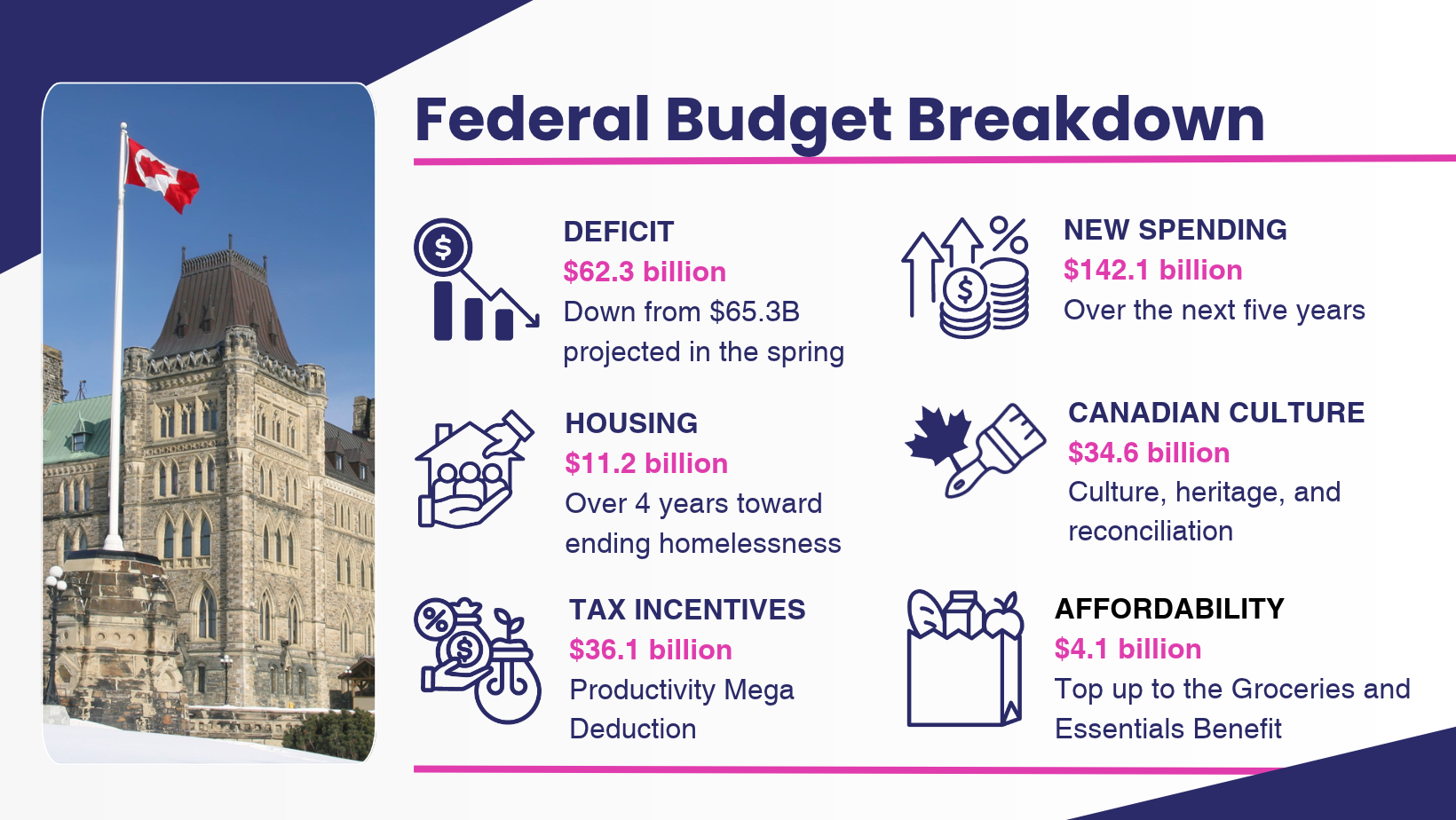
The government’s growth strategy bets big on backing Canadian talent and entrepreneurs. Building on September’s Productivity Mega Deduction, which allows businesses to write off new investments at a cost of roughly $36 billion over five years, Budget 2026 introduces the Canada Growth Incentive. The measure lets Canadian founders and investors keep up to $15 million in tax-free gains, and defer taxes when they reinvest the proceeds in another Canadian small business. Canada has long struggled to hold on to its most promising companies, and the government is attempting to give them a reason to stay.
The budget also wants more Canadian ideas to become Canadian products. It expands the federal research and development tax credit, worth $930 million over five years, to cover some of the costs of bringing a product to market. Ottawa will also change how its research granting councils work and look at how universities and colleges can get more of their research out of the lab and into the market.
Core defence spending is projected to grow from $75.1 billion in 2026-27 to $99.2 billion in 2030-31, but most of that money was set aside in earlier budgets. As a result, Budget 2026 adds just $6.6 billion in new spending on defence, public safety and security over five years, compared with $34.6 billion for reconciliation, culture and heritage. That leaves little new detail on how the government plans to deliver on its NATO commitments.
Ottawa is also tidying up its long list of federal lenders and investors. The government plans to merge the Business Development Bank of Canada and Export Development Canada into a single federal development bank, widen what the Canada Growth Fund can invest in, and bring the Canada Infrastructure Bank, including the Indigenous Loan Guarantee Program, under the Finance Minister. It also fills in the details on the $25-billion Canada Strong Fund, the promised sovereign wealth fund that will invest in Canadian projects alongside private investors, with Canadians able to participate through Canada Strong Notes. The goal is fewer doors to knock on for federal financing and a greater share of the returns staying in Canadian hands.
Splitting the Bill on Housing
The government sets the ambitious goal of putting Canada on a path to end homelessness within 10 years, committing $11.2 billion over four years starting in 2027-28 and another $17.8 billion in later years. The money would create a new Integrated Supports Fund for housing that comes with health, mental health and addictions supports, build more supportive and transitional housing, put $2 billion into community mental health and addictions facilities, and renew the Reaching Home program for another decade. The catch is who pays for what. Given the provincial responsibilities, the federal government expects to negotiate with provincial and territorial governments on bilateral agreements for operational funding to strengthen wraparound supports. That split may be easier for provinces to accept than federal conditions on operating money.
On housing supply, the budget stays the course. It extends the ban on foreign buyers of existing homes for two more years, to January 1, 2029, while exempting new builds. Mortgage insurance changes taking effect February 1, 2027, will make it easier for small builders to finance triplexes and fourplexes, and will let private insurers back loans on buildings of five to 50 units, the “missing middle” homes that cities have been trying to encourage. A $100-million partnership with the Federation of Canadian Municipalities will help cities move permits online and use artificial intelligence to speed up approvals. Another $1.5 billion over nine years through the Build Communities Strong Fund will revitalize recreational facilities and give Liberal MPs announcements that will have a direct impact on constituents’ quality of life close to home.
Trump, Tariffs, and the Bottom Line
If there was any expectation that the U.S. midterm results would change the government’s budget plans, there’s little evidence of that. Instead, the budget leans on revenue that may not last. Counter-tariffs on U.S. goods push customs duties up to $13.4 billion in 2027-28, but the budget only assumes they stay in place until then, and that revenue drops to $8.1 billion the following year. Higher oil prices are also lifting revenues. Against that, the government is making commitments that run for a decade or more, from the permanent Mega Deduction to the 10-year homelessness plan. It’s a bet that growth arrives before the windfall fades. In the meantime, about $11.5 billion of the nearly $15 billion in new spending in the competitiveness chapter goes to programs that support workers and businesses hit by tariffs and help them find new markets.
That extra room is already showing up, with last year’s deficit now expected to come in $27.5 billion lower than the spring forecast. Rather than bank all of it, the government is spending some on tariff relief and some on building. A new major projects management entity will help approved projects move faster, starting with the Mackenzie Valley Highway in the Northwest Territories, which has $3.1 billion set aside over five years. The government is also paying for a second one-time top-up in a year to the Canada Groceries and Essentials Benefit, a 50 per cent boost in early 2027 for more than 12 million Canadians, at a cost of $4.1 billion. It is the most direct answer in the budget to the cost-of-living pressures Canadians say matter most.
Ottawa’s Energy Power Play
Energy and major projects remain at the centre of the government’s growth case. The budget highlights Pacific Link and the Roberts Bank Terminal 2 port expansion, both named projects of national interest in October. It commits to working with the provinces to better line up their carbon pricing systems, and to changing the Clean Electricity Regulations so existing power plants can run longer and natural gas has more room in the near term, while keeping the goal of a net-zero grid by 2050. That flexibility is what Alberta, Saskatchewan and Nova Scotia have been asking for.
There’s also a push for greater investment in grid infrastructure, with the Clean Technology and Clean Electricity investment tax credits extended to 2040, the clean electricity credit opened to the largest high-voltage transmission lines within a province, and $37 million to study new links between provinces. Recognizing that the emphasis on Pacific Link could ruffle some environmentalist feathers, the government is also topping up the Smart Renewables and Electrification Pathways Program as part of nearly $4 billion for power infrastructure over 10 years.
Ottawa also says it will work with interested provinces on new ways to pay for the largest electricity projects. For utilities and developers, tax credits that last longer mean more certainty to plan projects that can take a decade to build, and for the government, keeping the Premiers onside is key to getting that grid built.
A Smaller Deficit, A Bigger Bill
The budget’s numbers look better than they did in the spring, but the deficit isn’t going away. Ottawa projects a $62.3-billion deficit this year, easing only to $52.9 billion by 2030-31. The budget points out that Canada has the lowest net debt as a share of its economy in the G7, but it is still borrowed money. Interest on the federal debt is projected at $60.2 billion this year, more than Ottawa sends the provinces through the Canada Health Transfer, and is set to climb to $85.5 billion by 2030-31. The government notes that interest costs remain low compared with the 1990s, but every dollar spent on interest is a dollar that can’t go to the affordability measures Canadians are asking for.
The Opposition Finds its Ammunition
Conservative Leader Pierre Poilievre was quick to respond, calling it “Carney’s Costly Credit Card budget” and warning it will mean “higher inflation and interest today and higher taxes tomorrow.”
Expect immigration to be the Conservatives’ next line of attack. The budget holds the targets at 380,000 new permanent residents and 370,000 new temporary residents a year through 2029, but also opens a path for up to 200,000 temporary residents already in Canada to become permanent residents by the end of 2027. The Canadian Press reports that, counting that program and an existing one, Canada could add more than 600,000 new permanent residents next year.
NDP Leader Avi Lewis called the budget “Christmas come early for CEOs, foreign investors and arms dealers,” saying it talks a lot about affordability but does little to lower costs. He singled out the $36-billion Mega Deduction as the budget’s biggest item and criticized the lack of any new measures to make the wealthiest pay more, renewing his call for a wealth tax.
The budget is big on ambition, but the real test is delivery. Major projects, new trade corridors and investment incentives are designed to build a stronger, more independent Canadian economy. But those investments take years to pay off, while Canadians are struggling with the cost of living today. The government’s challenge is to build for the next generation while easing the pressures facing this one. Ottawa has made its case for Canada’s economic future. Now it needs to make that future feel within reach.
New West is here to help you make sense of Budget 2026 and explore how your organization can thrive in this evolving landscape. Let’s connect.