
Alberta Budget 2026
Alberta Budget 2026 is a deliberate political choice to hold the line
Budgets are about choices. They are political documents that reveal what a government thinks it can defend, what it thinks the public will tolerate, and what risks it is prepared to carry.
Alberta’s 2026 budget is not designed to surprise anyone. It is designed to stabilize. This is not an election budget, and it does not read like one. Instead, it reflects a strategic decision by Premier Smith and Minister Horner to hold a line through a period of pressure and uncertainty, while keeping future political options open.
Let’s dig into the politics of what this budget shows.
Operating spending increases across almost every department. On its face, that is the kind of topline fact that will invite criticism from fiscal hawks, but should we ask if fiscal hawks are an endangered political species in Alberta?
The deeper political aspect is that these increases are not about getting ahead of future challenges. They really only address population growth and the natural inflation of service delivery in a fast-growing province. In other words, this is not a budget built around a new agenda. It is a budget built to keep the existing system functioning without inviting a larger fight over cuts that could be risky for government.
The capital plan reinforces this political posture. It is more politically attentive to communities outside Calgary and Edmonton, to the benefit of rural Alberta. Rural municipalities and regional leaders have been asking for more tangible investment and more visible acknowledgment that growth pressures are not confined to the big cities. Yet there are no major cuts to Calgary or Edmonton. The government is listening to its base without picking a side in an urban–rural divide, and it’s strategically smart.
An interesting implication is what this budget suggests about public tolerance for deficits in Alberta. Conventional wisdom often assumes Albertans have low patience for deficits. Recent experience suggests that view is overstated, especially when deficits are paired with service stability and a credible long-term plan.
This budget leans into this reality. It is not trying to win applause through dramatic restraint, and it is not trying to buy public support through a spending surge (at least until the next election?). What the government looks like it’s trying to do is reduce volatility and keep its broader political strategy on track.
The Fiscal Plan: Deficits are here for a long time, not a good time
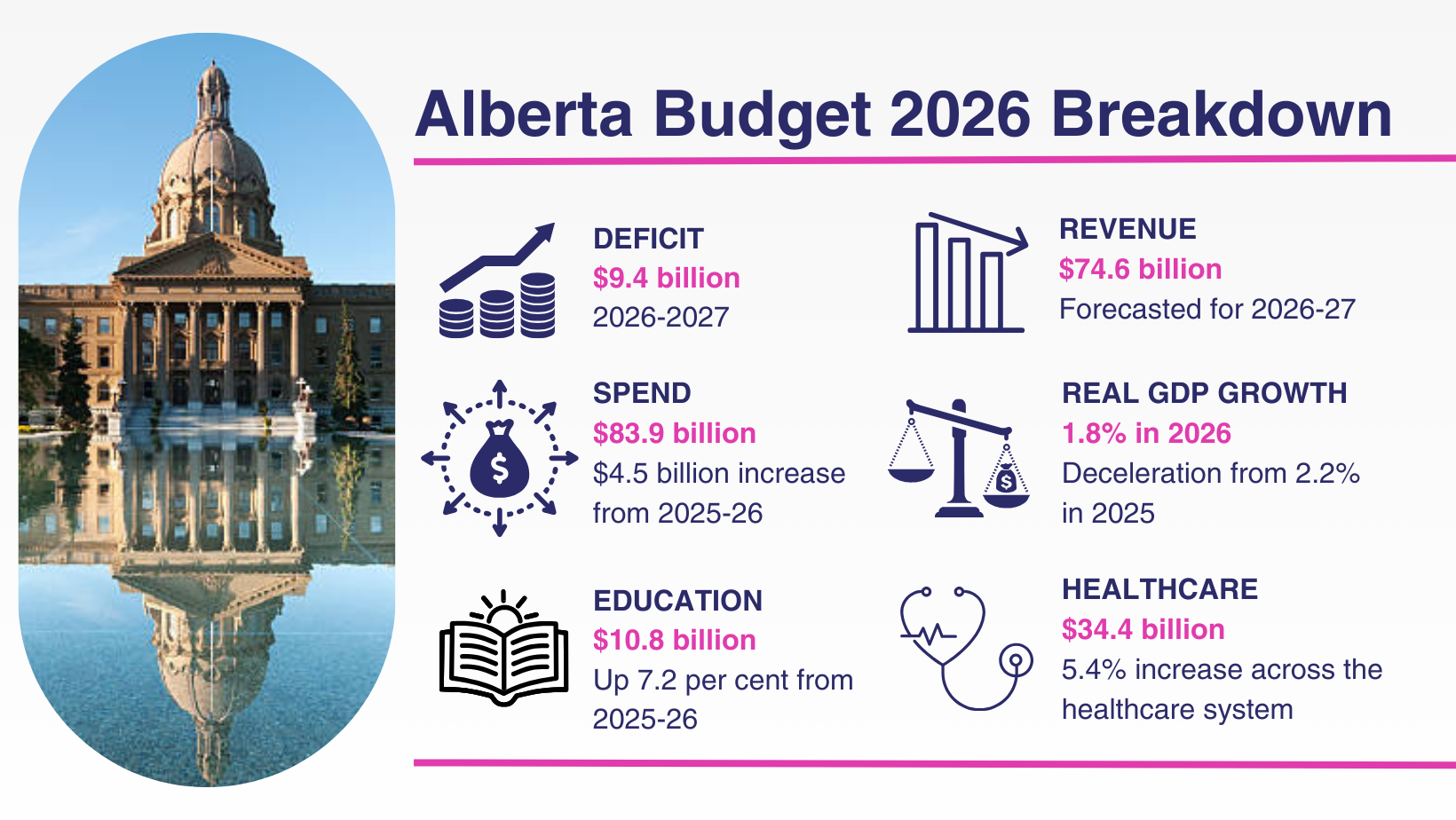
Alberta’s 2025 Fiscal Plan doesn’t beat around the bush or try to put lipstick on a pig. Over the next three years, the province will post deficits of well over $6 billion annually, with the worst of it landing now as the province faces a $9.4 billion shortfall.
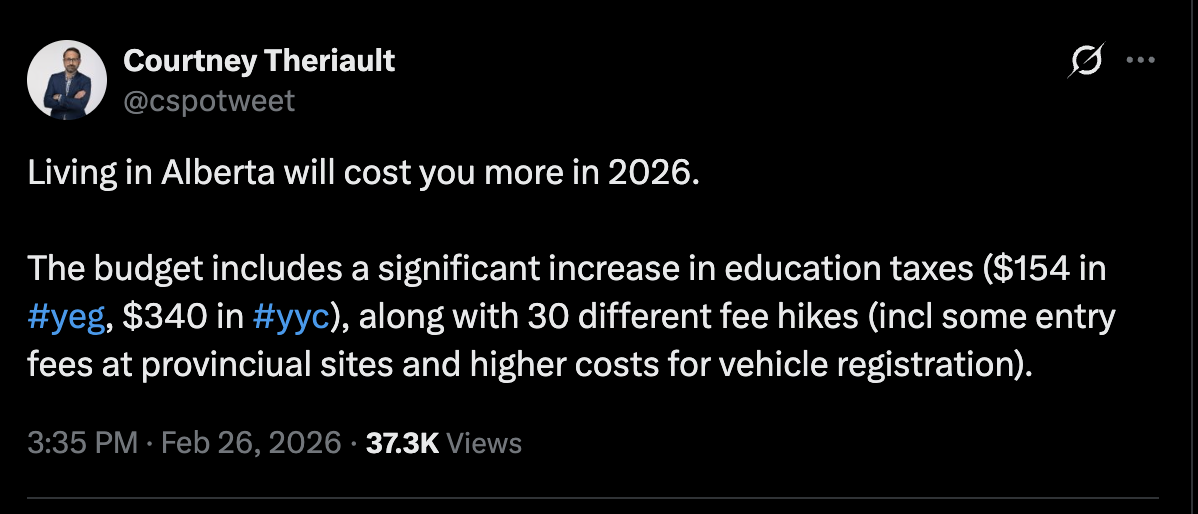
The more troubling story is on the revenue side. Alberta will take in $600 million less than it did last year and nearly $8 billion less than it did the last time that the Smith government posted a budget surplus in 2024-25. These declines, driven by lower commodity prices, have dented resource revenue to the tune of $3.1 billion from last year. While the province will see modest increases in personal income tax revenues and federal transfers, it won’t be nearly enough to patch the hole left by declining royalties. Finance Minister Horner has responded by increasing Education Property Tax, hiking the tourism levy, and implementing a range of new fees on vehicle rentals in 2027.
Fiscal Framework: Rules were made to be broken
Rules are meant to be broken - or at least revisited - and that’s the awkward subplot unfolding alongside this year’s fiscal plan. In 2023, the Alberta government introduced a fiscal framework which mandates against three consecutive deficits and caps the size of allowable deficits. At $9.4 billion, the deficit in Budget 2026 exceeds the framework by more than $4 billion.
The Alberta government is now projecting multiple years of deficits and will repeal its 2023 law.
Energy Sector Projects: Finding the bottom of the barrel
The health of Alberta’s treasury has long been tied to the global price of oil. For every dollar the price per barrel falls, the Government of Alberta loses an estimated $750 million in revenue. The province is forecasting WTI prices at $60.50, which means its estimate for non-renewable resource revenue is down to $13.2 billion, a 19% decrease from last year.
The government believes non-renewable resource revenue will recover to $16.9 billion by 2028-29, supported by higher prices and increased production.
Infrastructure Plan: Rural Alberta investments, no big city cuts
Alberta will increase its capital spend to $28.3 billion over the next three years to build public infrastructure across sectors. The focus is on healthcare and education. The health sector will see an increase of $1.3 billion compared to the last three-year plan, with much of the new funding heading to southern Alberta to build a replacement hospital in Cardston and make significant upgrades to hospitals in Lethbridge and Medicine Hat. In Education, the Smith government continues to implement its plan to build 200,000 new student spaces by investing $712 million in new capital funding for the K-12 education system, including $600 million for modular classrooms.
While big cities won’t see any cuts, infrastructure across the province is already stretched thin. In Calgary alone, the population has grown by 19.4% over the past five years, and Alberta’s total population is projected to surpass British Columbia’s potentially as early as 2038. From hospitals to transit networks, cities large and small, and rural communities alike are strained. Even with increased capital investments, the rate of growth means pressure on public infrastructure will continue to mount, underscoring the challenge of meeting population-driven demand.
Healthcare pressure points
Healthcare remains the government’s dominant service priority. At $34.4 billion in total spending, it accounts for the largest single commitment in the budget. Within that envelope, $1.9 billion in new funding is directed toward wait-time reduction and patient flow. The strategy is to move patients through the system faster.
Budget 2026 prioritizes visible service capacity in health care while advancing system redesign. The government is betting that voters will judge it first on whether wait times fall and emergency rooms stabilize. The financial commitment is substantial, but whether it is sufficient depends on whether the system can increase throughput faster than demand rises.
”Record” spending, lingering pressure: Alberta’s plan for education
Budget 2026 sets a new record for education funding in Alberta with $10.8 billion allocated. Yet despite the headline figure, Alberta’s per capita education spending remains comparatively low, meaning overall increases have not kept pace with the demands of rapid enrolment growth and rising classroom complexity. This budget outlines preliminary steps to address pressures, including hiring 1,600 new teachers, 800 support staff, and dedicating $355 million to addressing classroom complexities in the next year. With a substantial portion of the total budget going to teacher compensation, little is left for increasing the number of student spaces at the rate necessary to meet current enrollment numbers.
Alberta’s population growth shows little sign of slowing, and without continued large-scale investment, the education system will struggle to keep pace and meet outcome expectations.
Budget 2026 draws mixed reaction
The Alberta NDP framed the budget as evidence of UCP mismanagement, with Leader Naheed Nenshi calling it a “placeholder” plan that banks on higher oil prices while increasing fees and debt. He argued it fails to lower living costs, rebuild strained public services, or present a credible path to balance, instead saddling future generations with mounting liabilities.
Municipal leaders offered mixed reactions. Calgary Mayor Jeromy Farkas criticized rising education property taxes, noting Calgary taxpayers now remit more than $1.1 billion annually to the province without clear local reinvestment. The Mayor of Edmonton, Andrew Knack, described the budget as largely status quo, welcoming school investment but questioning stagnant municipal funding amid rapid growth.
Alberta Municipalities (ABmunis) was sharper in tone, warning that while the province says it is not raising taxes, Budget 2026 effectively shifts costs onto property taxpayers.
Holding the line … for now
Budgets are where governments decide what matters most, what can wait, and how much risk they are willing to take. In Budget 2026, Alberta’s UCP government made a strategic choice to hold the line - increasing spending largely to keep pace with population growth and service pressures, while avoiding dramatic cuts or sweeping new commitments.
Against the backdrop of an October referendum and an ever-evolving relationship with Ottawa, the government is betting Albertans will tolerate a large deficit. A more ambitious election offer will come later.
Questions about the budget? Don’t navigate it alone. The New West team is ready to help you understand what the numbers mean for your organization, anticipate political risk, and position you for what comes next.