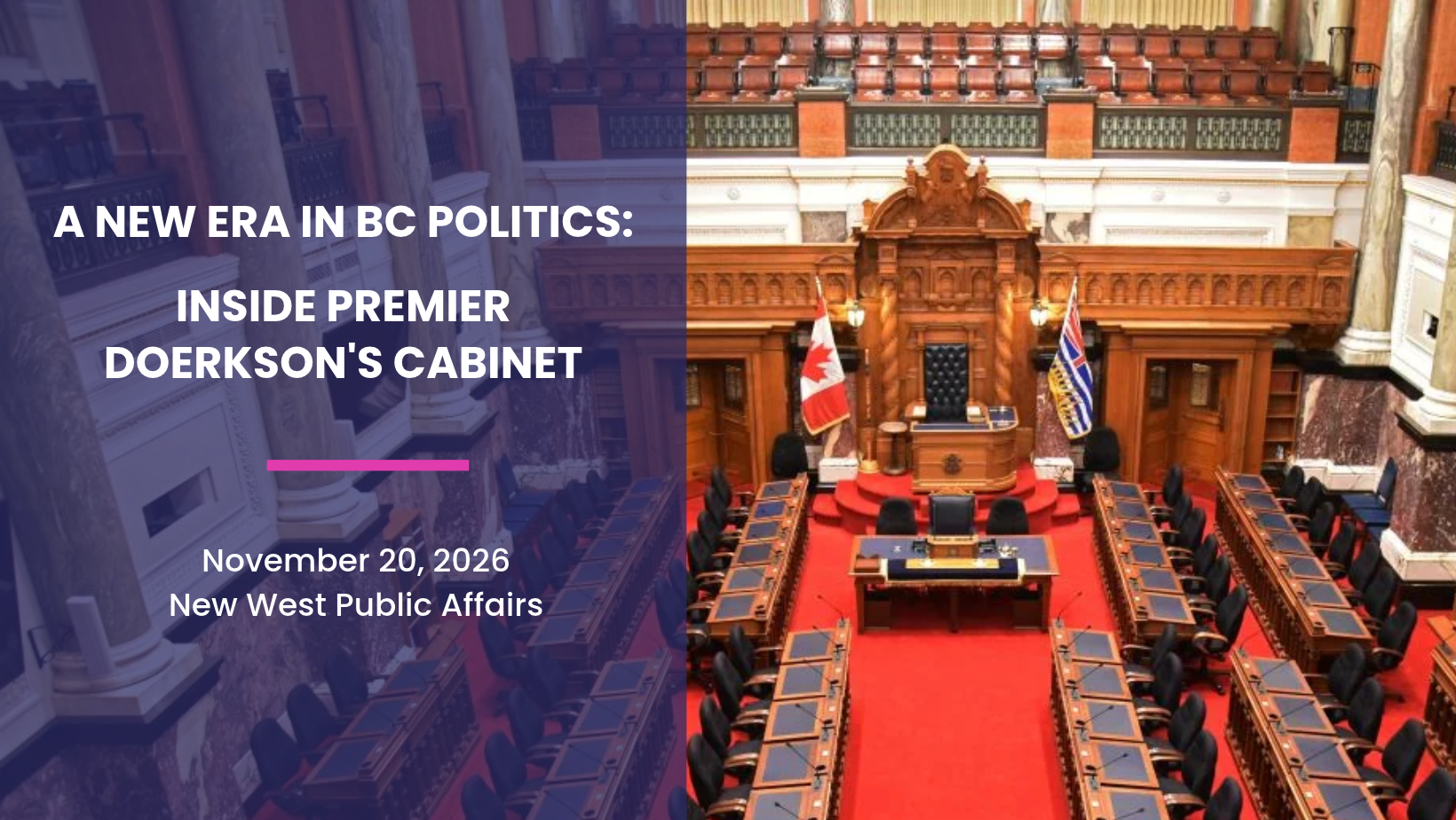
This morning, Lorne Doerkson was sworn in as British Columbia’s 38th premier at Government House in Victoria, alongside a cabinet of 18 ministers and six ministers of state. It is the province’s first Conservative government since 1928, and it holds 64 of the legislature’s 93 seats after the October 24 snap election.
The new government has promised an independent review of the province’s finances on day one, an income tax cut, repeal of the Declaration on the Rights of Indigenous Peoples Act (DRIPA), a doubling of natural gas production by 2032 and support for the Pacific Link oil pipeline. It inherits a record $13.8-billion deficit forecast for this fiscal year and a forest sector facing U.S. duties and tariffs of almost 35 per cent.
What Does It Mean?
Doerkson’s cabinet is built to reunite a party that fractured two months ago. Peter Milobar, who left the Conservatives under former leader Kerry-Lynne Findlay and briefly led CentreBC, returns as Minister of Finance, and several of the MLAs who followed him to CentreBC also landed portfolios, including Ian Paton (Agriculture), Bruce Banman (Citizens’ Services and Technology), Á’a:líya Warbus (Environment) and Donegal Wilson (Water, Land and Natural Resource Operations). Skeena MLA Claire Rattée, who was readmitted to caucus by Doerkson in September, becomes Deputy Premier and Minister of Social Development. Caroline Elliott, who narrowly lost the leadership to Findlay in May, is Attorney General. Taken together, the lineup signals a centre-right, business-oriented government closer to the old BC Liberal coalition than to the party Findlay led.
The economic portfolios go to ministers who have worked in related industries. Forests Minister Kiel Giddens managed public affairs for TC Energy’s Coastal GasLink pipeline. Energy, Mines and Petroleum Resources Minister Larry Neufeld is an engineer from Peace River South, the heart of the Montney gas play. Economic Development and Tourism Minister Gavin Dew sat on the boards of the Business Council of British Columbia and Resource Works. Health goes to rookie MLA Ryan Peterson, who became chair of the Business Council in May, and former Canadian Taxpayers Federation director Carson Binda becomes Minister of State for Red Tape Reduction.
Government is also smaller, with Doerkson cutting the number of ministries from 23 to 18, moving mining, housing, labour and emergency management to ministers of state, and “climate” has disappeared from the energy ministry’s name in line with the platform’s pledge to repeal CleanBC. Parliamentary secretaries for Metro Vancouver, TransLink, ICBC and Armed Forces and Veterans Affairs map directly onto platform commitments.
Experience is thin. Only six Conservative MLAs had three or more years in the legislature heading into cabinet-making, and the one former cabinet minister in caucus, Teresa Wat, was left out. Resource portfolios tilt to the North and Interior, reflecting a premier from Williams Lake, while four Surrey and Delta MLAs hold posts including Public Safety and Transportation.
Indigenous relations will define the first year, and Indigenous Relations and Reconciliation Minister Scott McInnis led the Conservatives’ calls in opposition to repeal DRIPA, which Doerkson has called his top priority. Repeal will not end the constitutional duty to consult, the Cowichan Tribes title appeal or the Federal Court challenges at least 10 First Nations have filed against Pacific Link’s national-interest designation, and the platform also commits to honour existing First Nations agreements and rebuild BC’s Indigenous equity-financing program.
The Conservative platform, Ready to Deliver, opens doors across sectors. Energy and utility companies face a rewrite of the rules for gas supply, grid connection and project review, including fixed in-service dates for transmission into the northwest, northeast and southern Interior and private power sales to off-grid mines. Mining and forestry proponents are promised legislated permitting timelines and, for forestry, a 45-million-cubic-metre harvest floor (up from the 29 million the current budget assumes). Employers gain a three-year PST exemption on machinery, equipment and software. In health, a Universal Health-Care Guarantee and portable long-term care funding open the door to private and non-profit providers. Organizations that sell services to government should prepare for a 20 per cent cut to consulting and professional-services contracts.
Who’s Running the Ministries?
Doerkson’s first deputy minister list leans on continuity, with change concentrated at the top. Kim Henderson, who chaired the transition and was deputy minister to the premier under Christy Clark until 2017, returns to that role as Cabinet Secretary and Head of the Public Service, replacing Shannon Salter. Of the 24 names on the list, 20 already sat on the Deputy Ministers’ Council under Eby, and most of them have moved to new files rather than out of government.
What Comes Next?
Doerkson will launch an independent review of the province’s finances, which will report before the government’s first budget and frame every spending and tax decision that follows. Ministers will receive mandate letters in the coming weeks as political staff are appointed.
With no fall sitting, the legislature returns in the new year for a Speech from the Throne, Budget 2027 and expected DRIPA repeal legislation. Judicial recounts take place next week in Kelowna Centre, where Children and Family Development Minister Kristina Loewen leads by 43 votes and has yet to take her seat, and in NDP-held Ladysmith-Oceanside, but neither will affect the government’s majority.
New West Public Affairs is following the transition closely and is ready to help clients make sense of the new landscape in Victoria.