2026 Ontario Budget Analysis
Betting on Growth
Ontario’s 2026 Budget is a wager. Faced with global economic instability and escalating U.S. trade pressure, the Ford government is choosing to spend more, tax less, and build faster, betting that private-sector growth will carry the province through. The strategy is rooted in economic self-reliance with a clear focus on making Ontario a more attractive place to invest, build, and scale.
Instead of balancing the books in the short term, the province is hoping it can insulate itself from external shocks by controlling what it can domestically. This means costs, approvals, infrastructure, and labour mobility. The risk is this bet will only work if growth shows up.
Fiscal Framework
The Ante: Investment Incentives and Cost Relief
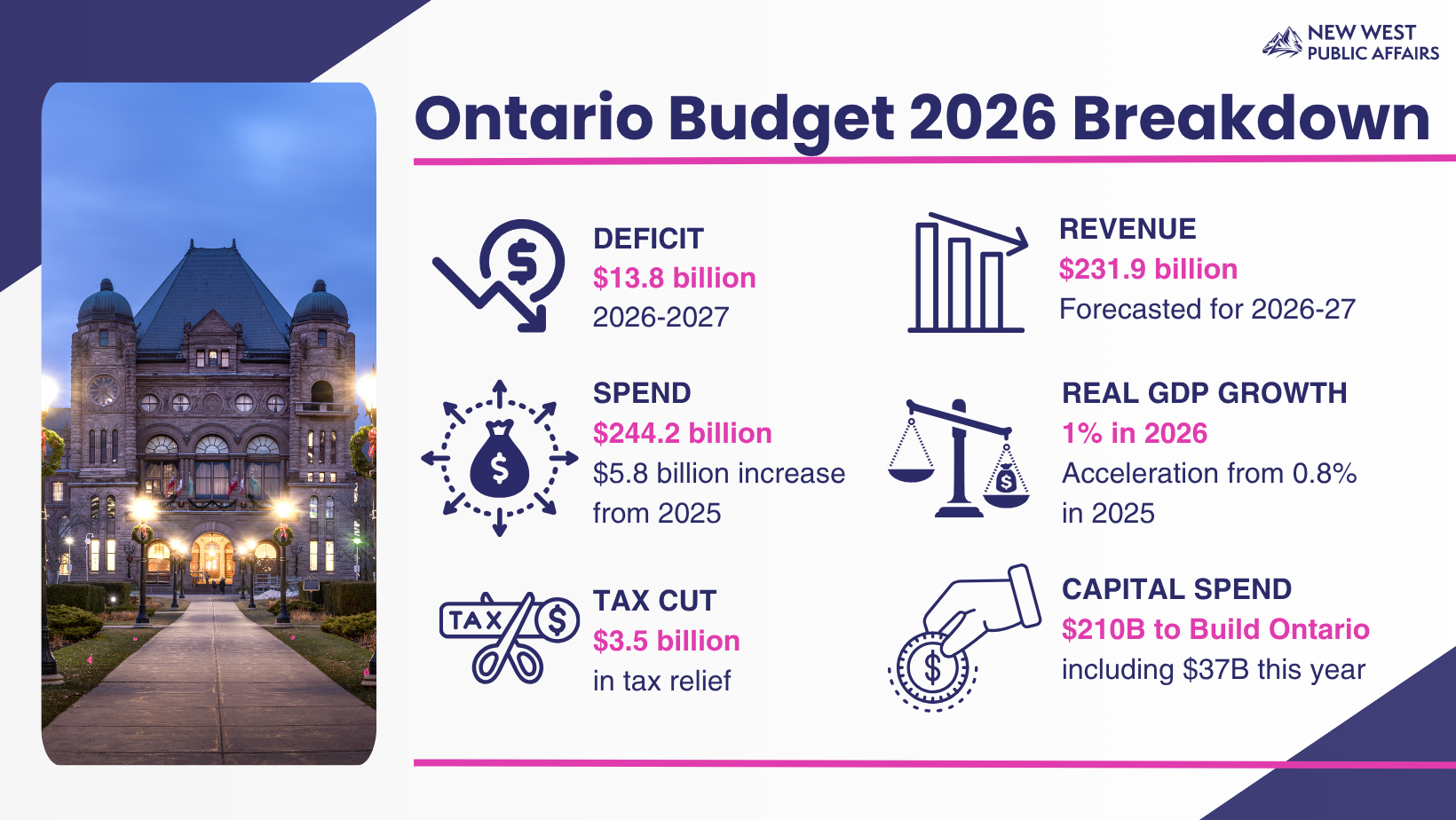
The budget is laying the groundwork to cash-in on private-sector growth. Key initiatives include a reduction to the small business tax rate, which the government says will return $1.1 billion to more than 375,000 businesses, along with $3.5 billion in accelerated write-offs designed to encourage capital spending. The province is also proposing Special Economic Zones to speed up major projects and a new Protect Ontario Account Investment Fund, with up to $4 billion intended to attract pension and institutional capital into infrastructure, energy, and critical technologies. Together, these measures suggest a more active provincial role in shaping and supporting investment - effectively positioning the Ontario government as a co-investor.
The budget also includes several measures aimed at reducing operating costs and improving the business environment. Fuel tax cuts of 5.7 cents per litre on gasoline and 5.3 cents on diesel fuel are being made permanent. WSIB premiums have been reduced to $1.23 per $100 of payroll, which the government describes as the lowest rate in more than 50 years, and the Employer Health Tax exemption has been increased to $1 million. In addition, the province is introducing a centralized digital permitting system intended to streamline approvals and reduce administrative delays. Taken together, these measures are meant to lower costs, improve certainty, and make Ontario a more attractive place to invest, although their long-term fiscal impact will depend on whether the expected economic growth materializes.
Build Big, Build Fast - Infrastructure as the Main Event
Ontario is moving ahead with a capital plan of more than $210 billion over 10 years, including $37 billion in 2026–27 alone. The emphasis is on the usual heavy hitters: highways, transit, health infrastructure, and energy systems. That includes continued progress on Highway 413, the Bradford Bypass, and major transit expansions across the Greater Toronto and Hamilton Area.
Energy sits at the centre of the infrastructure strategy. The province is advancing early planning work for the Wesleyville nuclear facility, investing $1 billion in small modular reactors at Darlington, and examining further expansion at Bruce C alongside refurbishment at Pickering. These efforts are also tied to ongoing calls for federal support through tools such as the Canada Growth Fund and extended clean energy tax credits.
Housing is being treated with similar urgency, at least on paper. Ontario recorded 62,561 housing starts in 2025, well below the roughly 100,000 annual starts needed to stay on track for the government’s 2031 target. The budget’s response combines tax relief with infrastructure support. Measures include removing the provincial portion of HST on new homes up to $1 million, eliminating the 8 per cent provincial HST on purpose-built rental housing, increasing the Municipal Housing Infrastructure Program to $875 million, and enabling access to up to $1 billion in Infrastructure Ontario loans. These HST changes alone are expected to cost the province $1.4 billion, but the logic is straightforward enough - if the market is not building at the pace required, the government is prepared to reduce some of the friction and absorb some of the cost.
The Social Spend: Playing Catch-Up on Care
Healthcare remains the largest area of spending with increased investment anchored by the $3.4 billion Primary Care Action Plan and a commitment to connect every Ontarian to primary care by 2029.
Increases are also going to targeted programs that have been facing mounting capacity pressures. Funding for the Ontario Autism Program is nearing $965 million annually. In mental health and addictions, the province is shifting direction, winding down supervised consumption sites and redirecting nearly $550 million toward recovery-focused HART hubs.
Beyond healthcare, the broader social system is largely being maintained rather than expanded. Childcare funding of $3.6 billion is extended for one year, with a $695 million top-up to hold parent fees steady, while ODSP and ACSD rates increase by 2.8 percent and the Canada Disability Benefit is exempted from claw backs. Additional funding for public safety, including Operation Deterrence 2.0 and school resource officers, reinforces this government’s continued focus on frontline response.
Degrees, Dollars, and a Tuition Reset
Tuition is back. After years of freezes, increases of up to 2% annually are being reintroduced for three years. Modest as that sounds, this move, along with recent overhaul of OSAP grant-to-load ratio, signals a rebalancing of who is expected to carry the cost of the system. Post-secondaries can expect significant support though, with the province putting $6.4 billion over four years into a new funding model that adds 70,000 new seats across high-demand fields. Through an approach that funds education from a workforce lens, this budget aims to fill labour gaps and stabilize institutions simultaneously.
At the K–12 level, investment is smaller but targeted. A notable new initiative, the $66 million annual Classroom Supplies Fund, gives each elementary homeroom teacher a $750 allocation for classroom materials. A practical way to invest resources directly into classrooms.
Economic and Carney Context
Minister Bethlenfalvy's budget is structured around a central theme of economic self-reliance. Ontario is seeking to weather external shocks by making itself a more attractive jurisdiction for investment.
Tariffs are the pressure point sitting behind many of the budget’s major choices. Ontario’s manufacturing base was built to benefit from deep integration with the United States. In a more protectionist environment, that same integration now creates real exposure.
Against that backdrop, the Ford-Carney relationship has taken on greater strategic importance. What may have once looked like routine cooperation now looks more like a serious partnership between two governments dealing with the same problem.
The December 2025 “one project, one review” agreement with the federal government is the clearest sign of that shift. At the same time, the relationship is not without tension. Premier Ford still needs federal capital, policy support, and regulatory cooperation to advance key elements of the province’s agenda. Understood this way, the requests embedded in this budget of the Carney government are the public expression of a broader negotiation.
The budget is quite explicit in its asks of the federal government. On energy and infrastructure, Ontario is seeking, streamlined approvals and extension of clean energy investment tax credits. The housing measures require federal cooperation on development charge reform funding. The CWELCC extension is a one-year hold while federal-provincial renegotiation continues.
Opposition Reaction
The NDP gave the budget a “failing grade” across five priorities including cost of living, healthcare and education, housing, employment, and fiscal responsibility. NDP Leader Marit Stiles and Shadow Finance Minister Jessica Bell critiqued the budget as delivering cuts to education, post-secondary, and job training while funding “vanity projects.”
The Ontario Liberals focused their criticism on housing. Liberal Housing Critic Dr. Adil Shamji called the one-year HST rebate insufficient in the face of Ontario’s low housing start numbers. The Liberals also pointed out that the government had rejected an identical HST proposal from them six months earlier.
Green Party Leader Mike Schreiner criticized the budget for prioritising corporate interests and large infrastructure projects over affordability, environmental protections, and frontline services.
Looking Ahead - Growth as the Exit Strategy
Ontario’s 2026 budget is a bet that the province can stay ahead of the risks closing in around it. The tariff threat is real and Ontario doesn't have the luxury of waiting for conditions to stabilize. Facing these conditions, Minister Bethlenfalvy's answer is to make Ontario a more attractive place to invest and is looking to Ottawa for the pieces Queen's Park can't fund alone. It's a coherent strategy but one that only works if the bet on Ontario's growth proves correct. Right now, that's the one thing nobody can guarantee.
The post-budget legislative calendar runs through the spring sitting (expected to late June). Key milestones to monitor:
Tabling and passage of the Supply Act and legislation to enact 2026 budget measures
Estimates committee schedule where ministers appear to defend their ministries’ priorities and spending
Federal-provincial bilateral agreements: CWELCC renegotiation, development charge reform programme details, nuclear investments and ITC commitments
Regulatory filings: Special Economic Zone designations, conservation authority consolidation timeline, digital permitting system rollout
Rollout of program application windows
2026–27 fiscal year begins 1 April 2026
Next fiscal update expected fall 2026
Didn’t see the results you hoped for in this year’s budget? New West Public Affairs is here to help. If you’d like to discuss how these measures affect your priorities or explore engagement opportunities arising from the budget, please reach out.