
The Battle for BC
Resource development dominates as voters remain undecided
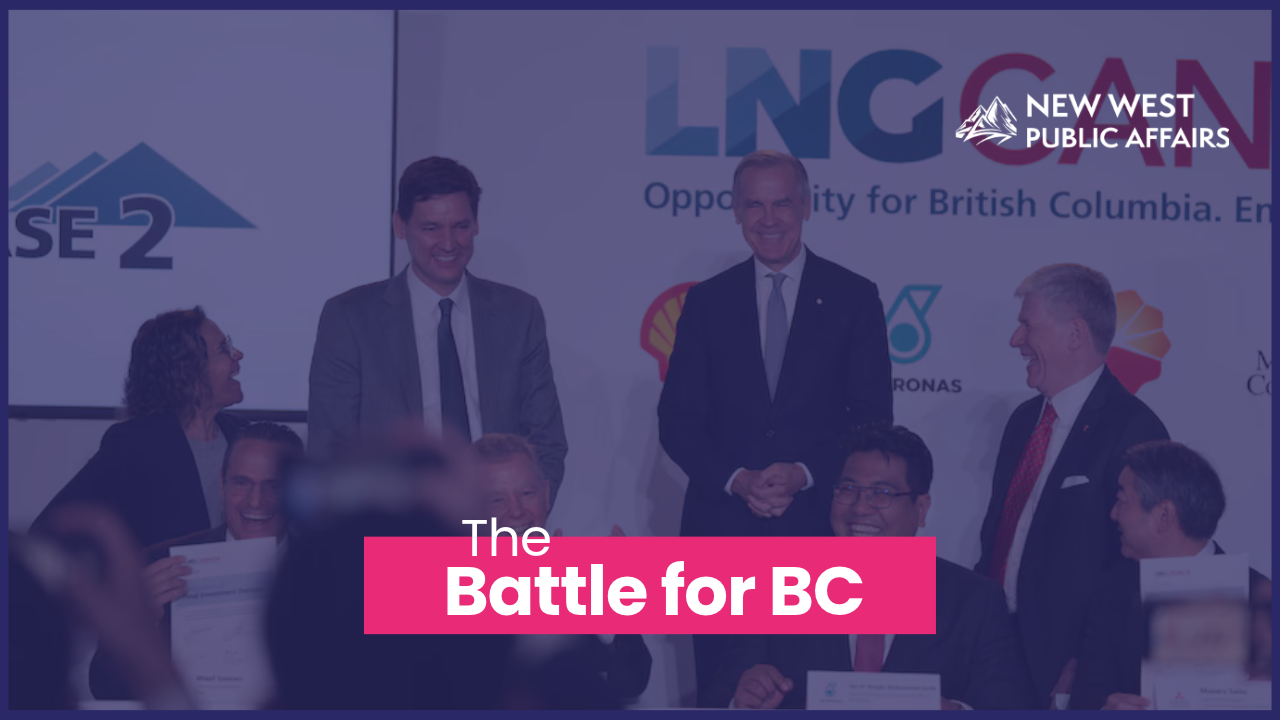
Resource development and the economy are dominating the second week of the campaign as LNG Canada confirmed it will move ahead with the $33-billion second phase of its massive export facility in Kitimat. The expansion would double the facility’s production capacity from 14 million to 28 million tonnes of LNG annually and could create up to 4,000 jobs at peak construction.
The Prime Minister made the announcement in Vancouver on Tuesday and party leaders were quick to compete over who could deliver more economic growth and new investment for the province. NDP Leader David Eby took creditfor the expansion, framing it as evidence of economic momentum under his party. The Conservatives pushed back, arguing the NDP has been too slow to embrace LNG development and blaming regulatory delay and uncertain permitting under Eby’s government for projects that have stalled or been abandoned.
Beyond LNG, the front-runners also laid out their visions for B.C.’s resource economy this week. Eby committed to doubling the production and export of critical minerals within five years, speeding up mine approvals, accelerating the North Coast Transmission Line and expanding the Port of Prince Rupert to open new trade opportunities. Doerkson countered with his “Energy Superpower” plan, promising to double LNG production by 2032 and triple it by 2035 through faster approvals, new energy infrastructure and a more competitive and stable royalty framework.
While the leaders sharpen their economic pitches, the latest polling suggests neither has sealed the deal with voters. A new survey from Leger shows the Conservatives have a narrow lead among decided voters at 39 per cent, compared with 36 per cent for the NDP, but more than a quarter of voters say they could still change their minds. That uncertainty comes amid broad dissatisfaction with the direction of the province: 58 per cent believe B.C. is on the wrong track, while 57 per cent disapprove of the decision to call an early election.
Yet frustration with the government has not translated neatly into support for the opposition. While only 19 per cent believe David Eby and the NDP have governed well enough to deserve another term, another 22 per cent say the government has performed poorly but still see it as the best option.
Others may be taking a closer look at the BC Green Party which is currently sitting at 13 per cent among decided voters. However, turning that support into results at the ballot box could be a challenge. The party currently has candidates in just 18 of BC’s 93 ridings and with nominations closing Saturday afternoon, the next few days will be critical to how large a role the Greens can play in the campaign.
Right now the Conservatives are leading the pack, but the polling shows voters have reservations there too. Fifty-seven per cent of British Columbians say they are concerned about views held by some of the party’s MLAs and candidates, while more than half express doubts about its leadership or say recent internal divisions make them less likely to vote Conservative. Those divisions have also reshaped the field, with OneBC and CentreBC each attracting five per cent support in the Leger poll and offering voters additional options on the right.
Adding to the uncertainty is the question of who would lead the Conservatives beyond election day. Interim leader Lorne Doerkson took over less than 48 hours before the election was called, following Kerry-Lynne Findlay’s resignation after a turbulent period that saw 13 MLAs leave the Conservative caucus. Doerkson quickly brought several members back into the fold, but the party’s constitution prevents an interim leader from simply transitioning into the permanent role. The party’s board has said it will pursue changes that would allow him to stay on, but those changes would require the support of two-thirds of members voting at an annual or special general meeting. That may be easier said than done in a party whose membership has recently shown just how closely divided it can be: Findlay won the leadership only four months ago with 51 per cent of the final-ballot points, narrowly defeating Caroline Elliott at 49 per cent.
With health care, housing affordability and the economy all competing as top concerns, and 28 per cent of voters still open to switching sides, watch for the parties to sharpen their pitches on each of these issues as they try to win over undecided and moveable voters in the weeks ahead.
New West Public Affairs is following the BC election closely and is ready to help clients make sense of the dynamic and changing landscape in the province.